
Help:Writing Character Pages: Difference between revisions
Muggshotter (talk | contribs) (Created page.) |
Muggshotter (talk | contribs) |
||
| Line 15: | Line 15: | ||
As a starting point, try to focus on the following: | As a starting point, try to focus on the following: | ||
* | * Sentences should not be very long if possible. Paragraphs are used by default. Bullet lists are not mandatory, but useful for listing key differences between ground and midair versions at a glance. | ||
* Some attacks in Dissidia can look visually complex for one image. In these cases, a short description for what a move looks like is recommended. | * Some attacks in Dissidia can look visually complex for one image. In these cases, a short description for what a move looks like is recommended. | ||
* Do not compare a move against older versions of the move unless there's a really good reason to do so. | * Do not compare a move against older versions of the move unless there's a really good reason to do so. | ||
Revision as of 18:25, 25 June 2025
This is a guide for writing character pages on Dissidia Wiki, namely for Dissidia PSP and Dissidia NT games. This guide goes hand-in-hand with the general Manual of Style, and it is take influence from both pages.
Emphasis on Competitive Play
At the time of writing, Dissidia Wiki prioritizes gameplay strategies and mechanics related to competitive play in multiplayer. Therefore content on this site should be in service of that first and foremost. The purpose of character pages is to inform how a character works in a competitive multiplayer setting.
Dissidia 012 character pages have a gallery page for translations, in-game profiles and such. These should be the primary source for content not related to competitive play.
This priority may change over time depending on Dissidia Wiki's existing coverage and volunteer staff.
Target Audience
The goal of Dissidia Wiki is to educate. Beginner and intermediate players take priority, but certain in-depth content in a character's strategy and matchup pages may cater to expert players as well.
As a starting point, try to focus on the following:
- Sentences should not be very long if possible. Paragraphs are used by default. Bullet lists are not mandatory, but useful for listing key differences between ground and midair versions at a glance.
- Some attacks in Dissidia can look visually complex for one image. In these cases, a short description for what a move looks like is recommended.
- Do not compare a move against older versions of the move unless there's a really good reason to do so.
- If a move is more commonly referred to by another name (such as an abbreviation or an alternate colloquial term), it may be helpful to add that alternate way of referring to the move in parenthesis either immediately after the first use of the move name. That makes it so from then on, you can use that alternate way of referring to the move for the rest of the page without worry of confusion.
- If a term is particularly obscure for beginners and otherwise uninformed, use the Keyword template.
Character Overviews
This is what introduces the reader to the character. Listed in order, an overview should establish...
- What kind of a fighter they are
- Are they a close-range melee character or a long-range zoner? Try to use a combination of "offense / defense", [range] and the most distinct aspect as an "elevator pitch."
- Warrior of Light is a close range fighter who operates as an all-rounder.
- Cecil is a close / mid-range character who functions with two different jobs
- Kefka is a defensive zoner who primarily operates at midrange and long-range to deal damage.
- Gabranth is a unique character who fills EX Gauge to quickly enter EX Mode.
- Unique mechanics
- Does this character have unique mechanics that they can use?
- Cecil is practically two characters in one, and he can switch between jobs at will. This requires performing certain HP attacks, which is a double-edged sword; etc. etc.
- By utilising his unique "Switch" mechanic, Vaan can access a different bravery attack based on the bravery he previously used.
If a character relies on a unique, but strong attack, the overview can be constructed around that as well.
- General Strategy
- How does this character succeed most of the time?
- Warrior of Light represents a standard-fare fighting style with quick Dayflash pokes, committal gap closers and midrange projectiles. His standard mobility lets him create offense and defense as needed, and once he gets an opening, his HP links can deal good damage.
- Cecil is not explicitly built for offense, or rock-solid defense. Instead, he works well as a punisher. Many of his moves have good reach, either vertically or laterally.
- Kefka's usual strategy revolves around creating space with reverse dashes and Precision Jumps and then casting his signature Waggly-Wobbly Firaga. This is a homing a projectile that fluctuates between Ranged Low and Ranged Mid priorities, and starts combos on hit. That creates an incentive for opponents to engage with Kefka, which sets up his bigger plays.
- Gabranth is the only character in the game to have HP attacks that cannot deal HP damage. This forms the crux of his strategy: Build EX gauge with the distinct EX Charge HP attack while fending off the opponent, then unleash EX Mode at will. Once in EX Mode, Gabranth becomes much stronger.
- Strengths
- Here, you can start going into detail about what makes a character strong, what they do well and if they have a strong unique attack.
- Cecil can punish opponents' whiffs effectively with both jobs, given the right matchup. Cecil has various solo combo routes, which he can setup with assist to suit his needs for damage or EX.
- Kefka's strengths are characterized by his space control, good defensive mobility and great damage potential. His high base ATK and base damage on braveries cause a lot of damage in assist combos.
- Gabranth's high movement speed, bravery damage and mid priority are all more prominent in EX Mode. The universal benefits of EX have a causative effect too; Gabranth reaps the benefits of added critical hits, health regen and assist gauge depletion more frequently over the course of a match.
It's also recommended to mention effective build styles while describing a character's strengths. Certain build styles work very well with specific characters, such as Side by Side for Kefka and Onion Knight, or EX for Sephiroth and Warrior of Light.
- As an all-rounder, Warrior of Light works with a variety of builds, including EX and Side by Side. His standout traits are defensively oriented; He has very high base DEF stat, which is greatly amplified in EX Mode.
- Warrior of Light also has an advancing frame 1 command block in Shield of Light, which is a 1-hit HP that wall rushes. This is not common in the game. It makes Warrior of Light's dodges safer and beating low priority attacks with long active frames easier.
- Weaknesses
- Here, you can contrast the strengths by highlighting what the character struggles with.
- Warrior of Light can struggle against lingering projectiles due to risky disjoints. His projectiles are serviceable, but often low reward at a distance. The reliance on HP links makes Warrior of Light susceptible to punishes after LV1 Assist Change.
- Cecil's frame data is below average, with long startup, animations and late cancel windows. Building assist gauge safely with whiffs is dangerous for Cecil as a result, which is a fundamental weakness in competitive play.
- Kefka's EX generation is low and thus relies on EX Cores, which limits his potential to use his powerful EX Mode. He takes big risks due to his attacks having Ranged Low priority, telegraphed startup or long recovery. This also puts him at risk in Assist gauge economy.
- Gabranth's reliance on EX demands time and strong defensive fundamentals. He can struggle against effective rushdown due to his floaty air dodges and relatively slow EX gain between interactions.
- Final paragraph
- This will end the character overview. It is kickstarted by a mention about prior competitive placement in community tier lists. Then, previously listed strengths and weaknesses may be put concisely into context on a macro-scale.
- In competitive play, Warrior of Light has been usually ranked at high tier. His fundamentally good moveset and stats lend to a consistent playstyle that adheres to the metagame.
- In competitive play, Kefka Kefka has been rated at high tier and mid tier. He thrives with momentum, but can also struggle a lot when it's not in his favor. His space control is good, even in small stages. While Kefka has answers to situations with fast attacks and single hit HPs, everything he does is committal as he has nothing with both fast startup and low recovery. Despite that, his defensive playstyle stands out in the roster and can reward dedicated players greatly.
- In competitive play, Gabranth has been ranked as a high tier and a mid tier character. Gabranth's matchups are rather volatile; His frequent access to EX mechanics is powerful against some of the best-in-class defense, which makes him very difficult to defeat over time. But he also struggles a lot against best-in-class offense, which can dismantle him quickly. Players who can stand their ground will find a rewarding character with a unique twist on the game's meter economy.
Unique Mechanic
If a character has a unique mechanic, it may be introduced after the overview.
Expand for an example with Cecil's Job System
Unique Mechanic: Job System
-
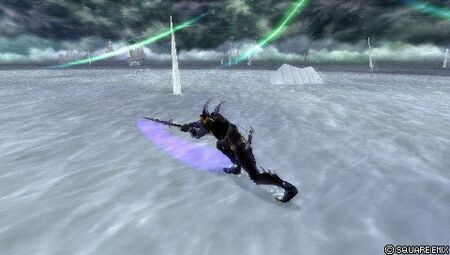
Dark Knight (Ground)
-
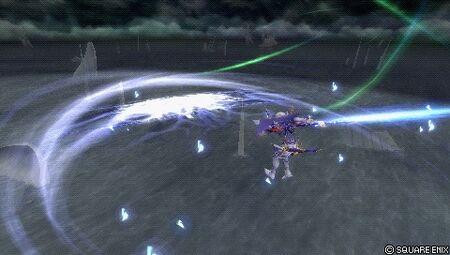
Paladin (Midair)


Cecil has two jobs, which have vastly different moves. Dark Knight is focused on ground combat, while Paladin is focused on aerial combat. Both jobs have their own set of ground and aerial moves, while HP attacks are universal. Cecil can only have one job active at a time. The job can be changed by using specific attacks. Cecil turns to Dark Knight with ground HP attacks or Dark Step (during Paladin). Similarly, Cecil turns to Paladin with midair HP attacks or Paladin Arts (during Dark Knight). Each attack must be equipped, or Cecil cannot perform them to change jobs.
Cecil will always start each fight as a Dark Knight. Therefore, Cecil must commit to specific attacks in order to access Paladin moves. This can be a risky proposition for Cecil due to his long whiffs, but it is a risk he has to deal with. If Cecil is in EX Mode, he can change jobs freely without attacking by pressing R + Square  +
+  .
.
Certain equipment also affect Cecil's stats when he is in a specific job, such as Cimmerian Edge  (ATK +1 in Dark Knight) and Lightbringer (DEF +1 in Paladin). In Dissidia 012, Cecil also has two new HP attacks; Shadow Bringer for Dark Knight and Luminous Shard for Paladin. Equipping one of these HP attacks prevents the other HP attack from being available. As a result, Cecil can only equip Shadow Bringer or Luminous Shard, but not both.
Writing Moves
Each move is accompanied by a data template and a separately written overview for the move. The data template does not need to be touched in most cases, so focus on writing an overview for the move instead.
If in doubt, use other pages as an example. Warrior of Light, Cecil, Cloud and Gabranth are all good.
Let's use Warrior of Light's Dayflash as an example.
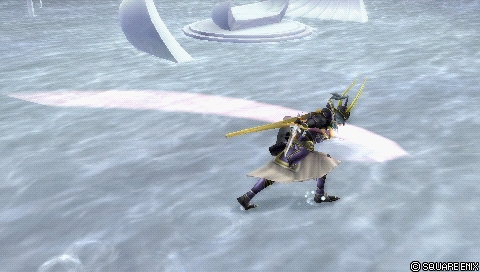
Introduction: Keep it to 1 line, briefly summarising the entire move and mention at least one key function.
Dayflash is Warrior of Light's main poke.
Primary function(s): Elaborate on the main purpose with more details, and why it is good at it.
Dayflash is fast, generates good 90 EX and works as an assist combo starter. It can be whiffed safely to build assist gauge due to its short recovery and multiple cancel options.
Secondary function(s): If a move has more than one role or distinct functionality, you can write about it in the next paragraph. This can charged versions of an attack, or a move's use as a whiff punish tool for example.
What can the move do when it hits: Combo possibilities, positional advantage, and so on. Depending on how important this is for the move in question, it can be incorporated into primary or secondary function.
On hit, Warrior of Light can perform two follow-up slashes with Circle
if the first hit connects. This 3-hit combo has a relatively long input window, which makes it good for hit confirming assist combos. The last hit leads to Chase. The low knockback angle and long chase prompt let Warrior of Light do empty chase to force a grounded wall rush.
- What weaknesses does this move have? Why is it relevant?
- If a move has prominent weaknesses, write about them here. Perhaps the move is only available on the ground, in a game where fights often take to the air. Maybe it's dangerous to miss or it's low priority, or it gives low reward on hit. Maybe the character relies on this move, but its flaws bring them down.
- Niche functionality
- If a move has unusual or niche utility that's worth knowing, you can write about it briefly. The more niche a technique becomes, the more likely it fits into the character's strategy page. In these cases, link to that section in the strategy page.
- An attack that has both ground and midair versions
- In most cases, both versions will function similarly. Make a note of this and highlight its importance for either ground or midair version, depending on which one is more important. This will be the midair version in most cases.
Dayflash's aerial version is essential for Warrior of Light. It's very similar to ground version in many aspects, including damage, hit confirmable follow-ups and safety as a poke. It's reliable for starting assist combos and it generates 90 EX when completed. Because fights often happen in the air, Warrior of Light relies on this move a lot to function.
After introducing similarities and key differences, you can use the second paragraph to elaborate on the different aspects and if this version is even more relevant for the character.
Ultimately, the reader should walk away with an understanding of the move's main purpose(s), strengths and potential weaknesses. If you can convey an accurate and fair assessment of a move in fewer words, you probably should do that. There is a lot to talk about with moves in Dissidia, so being concise lets readers absorb more relevant information without being overwhelmed.